
Despite ongoing reports of economic headwinds and uncertainties surrounding green finance, global spending on energy transition reached a record $2.3 trillion in 2025, according to BloombergNEF research published this week. Far from slowing down, investment in clean energy technologies continues to expand across multiple sectors, reflecting both the increasing importance of sustainability and the recognition that energy security and economic resilience are closely linked.
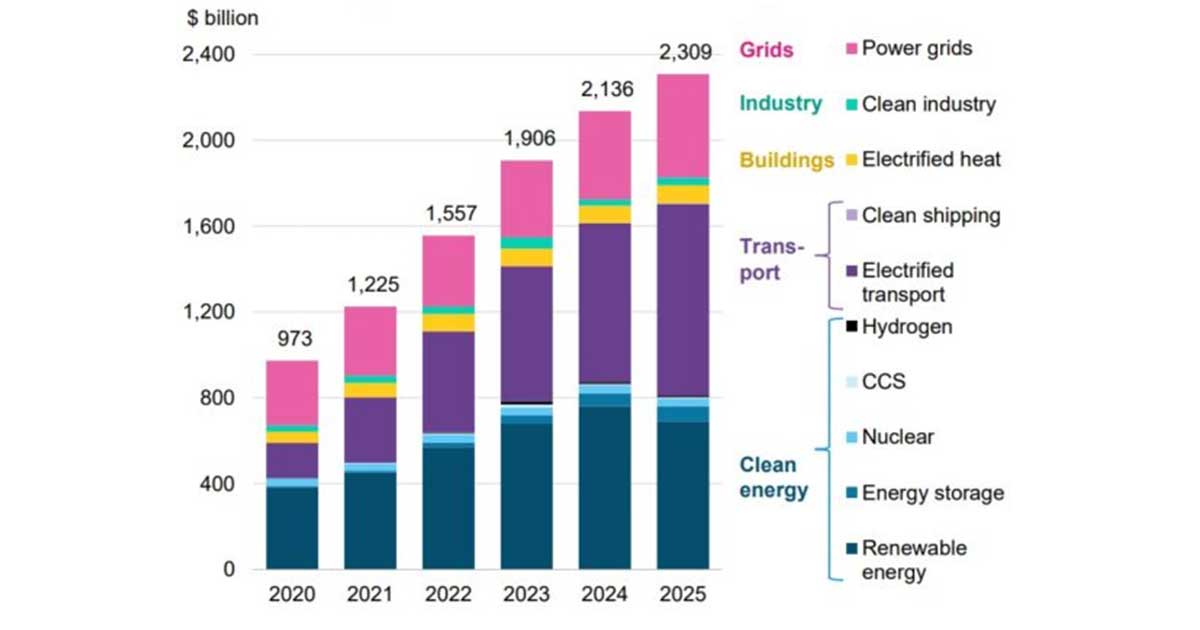 Source: BloombergNEF.
Note: CCS refers to carbon capture and storage.
Electrification and Diversified Investment
Electrified transport remains the largest single category of energy transition spending. Electric vehicles, charging infrastructure, and related technologies account for a substantial portion of global investment, reflecting growing consumer demand and government incentives in multiple markets. However, the investment picture is broader than headlines often suggest. Other areas, including clean technology deployment, expansion of green supply chains, equity investments in climate-tech, and project financing for renewable energy, have all experienced measurable increases. This diversified approach underscores the practical recognition that achieving energy and climate objectives requires coordinated action across multiple sectors.
Even in regions facing regulatory uncertainty or policy shifts, investment has continued to rise. For example, the United States saw a 3.5% increase in energy transition spending in 2025 despite trade restrictions, policy adjustments, and broader economic pressures. This trend demonstrates that, while government policy can influence investment speed, private capital and market forces are increasingly aligned with long-term energy transformation goals. BloombergNEF projects that global annual investment in the energy transition will reach $2.9 trillion within five years, signalling continued momentum and confidence in the sector.
Economic and Strategic Implications
These investments carry both economic and strategic significance. Large-scale spending on electrification, green supply chains, and climate-tech innovation generates jobs, stimulates industrial activity, and strengthens supply chain resilience. Investment in domestic clean energy reduces dependence on volatile fossil fuel markets, enhancing energy security for both industrialized and emerging economies.
Financing mechanisms play a key role in supporting stability. Equity investments, project financing, and green bonds are increasingly directed toward long-term, structured projects, reflecting investor confidence in renewable energy’s reliability and profitability. Projects with clearly defined costs, timelines, and revenue streams are more likely to deliver predictable outcomes and avoid undue risk. This methodical approach ensures that growth in the energy sector remains sustainable and aligned with economic and security objectives.
The Hungarian Perspective
For Hungary, the global boom in energy transition investment is more than a headline, it’s a roadmap of opportunities and practical lessons. While the country may not host sprawling offshore wind farms or massive solar megaprojects, Budapest can still harness the ripple effects of international investment. By plugging into global supply chains, accessing cutting-edge clean technologies, and joining international financing initiatives, Hungary can strengthen its energy security and modernize infrastructure without overextending domestic resources.
Regional collaboration is key. Cross-border projects, joint ventures, and EU-wide partnerships allow Hungary to tap into innovations and capital flows that might otherwise be out of reach. This approach lets the country benefit from global momentum, expanding capacity, improving efficiency, and fostering industrial competitiveness, while keeping projects realistic and fiscally responsible. In essence, Hungary can ride the wave of global energy investment strategically, turning external trends into domestic gains without taking unnecessary risks.
Outlook and Risk-Aware Planning
The record surge in global energy transition investment demonstrates that long-term momentum behind clean energy is robust. Electrification, supply chain development, climate-tech innovation, and structured financing are converging to create a diversified and resilient investment ecosystem. A careful, measured approach, prioritizing reliability, cost efficiency, and risk management, is essential to sustaining growth. Overextension, poorly planned subsidies, or speculative investments could undermine both economic stability and confidence in energy markets.
The projected rise to $2.9 trillion in annual investment by 2030 indicates that energy transition will continue to be a major driver of industrial transformation and economic activity worldwide. For Hungary and similar countries, the challenge lies in aligning domestic energy strategies with global trends: leveraging opportunities, fostering technological capacity, and maintaining energy independence while managing costs and risks.
Global energy transition investment is entering a new phase, marked by record spending, sectoral diversification, and sustained momentum even amid economic and political uncertainty. A measured, pragmatic approach, focusing on proven technologies, well-defined projects, and long-term stability, will determine whether the transition delivers lasting economic and energy security benefits.
References
BloombergNEF. (2026, January 26). BloombergNEF Finds Global Energy Transition Investment Reached Record $2.3 Trillion in 2025, Up 8% from 2024.
BloombergNEF. (2026). Energy Transition Investment Trends. BloombergNEF. (Report overview).
Energy Regulation Solutions. (2026, January 27). The Energy Transition Investment Trends Report. Energy Regulation Solutions. https://energy-regulation.de/the-energy-transition-investment-trends-report/
International Energy Agency. (2026). Global energy investment set to rise to $3.3 trillion in 2025 amid economic uncertainty and energy security concerns.
CarbonCredits.com. (2026). Clean energy investment hits record $2.3T in 2025 — EVs and renewables lead the surge. CarbonCredits.com. https://carboncredits.com/clean-energy-investment-hits-record-us-2-3t-in-2025-evs-and-renewables-lead-the-surge/
PV Tech. (2026). Global clean energy investment hits record US$2.3 trillion in 2025. PV Tech. https://www.pv-tech.org/global-clean-energy-investment-record-us-2-3-trillion-2025/