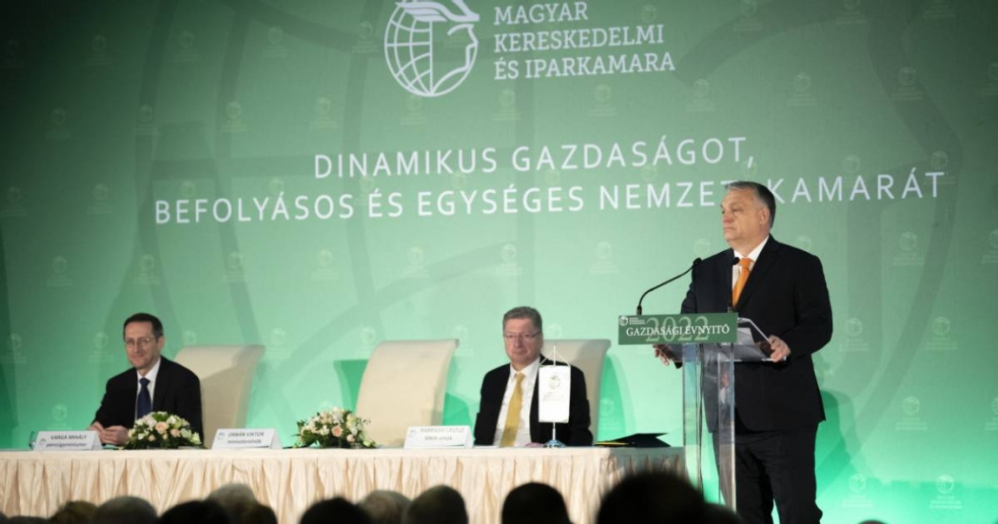

On 19 February, the Hungarian Chamber of Commerce and Industry held its traditional economic policy forum to mark the beginning of the business year. Speaking at the event, Prime Minister Viktor Orbán gave a detailed overview of the state of the Hungarian economy, including where the country has progressed from 2010 to the present and what the long-term goals are set for the year 2030. One such national strategic target is to increase the share of Hungarian-owned companies in the otherwise commendably growing export turnover. The goal is to reach 30 percent by 2030, up from the current share of only 20 percent; of course, an even better result would be more than welcome. The present article aspires to offer some tips and draw attention to the past and hoped-for future glory of the Hungarian energy industry. We aim to shed light on the fact that, by making use of existing knowledge and professional culture, the Hungarian energy industry could effortlessly become a key export sector again.
For decades, Hungary has become accustomed to importing a large share of its hydrocarbons (oil and gas). Domestic reserves that can be extracted using conventional technologies are dwindling and demand from the population, transport, energy production, and the chemical industry is on the rise. However, it is no recent development that the country also has to import a significant part of its electricity needs. The share of net electricity imports has reached extraordinary levels by European standards, averaging 32 percent between 2013 and 2020, but occasionally even exceeding 50 percent. Among European countries, only Lithuania, Luxembourg, Albania, and Croatia have higher import dependency.
Cheap imports have undeniably helped in maintaining affordable energy prices in the short term. From a security of supply perspective, however, the European energy crisis is a proof that both solar power, available 1600 hours a year, and wind power, available 2400 hours a year, have so far failed to replace conventional power plants, which are predictably available for up to 8760 hours annually. What next? Do we ‘dare to stay small’, or do we dare to think boldly, make Hungarian energy a key sector and aspire to export electricity to EU regions that are increasingly short of capacity?
As we have repeatedly made clear, the operation of the contemporary Hungarian electricity system that is both reliable and in line with climate policy objectives is best served by an optimally structured generation of renewables that is adapted to technical possibilities, a natural gas-fired power plant fleet that can ensure system-level balance and flexibility, and a carbon-free nuclear power plant capacity that guarantees security of supply. Thanks to the government’s greening ambitions, weather-dependent renewable generation capacity has grown and continues to expand dynamically. However, market-based investments to fossil power have been lagging for decades. Apart from the state-invested Paks II Nuclear Power Plant, no investor has embarked on building a new major power plant since 2009, as it is impossible to make business plans and calculate returns in a market where the intermittent production of weather-dependent renewables leads to unprecedented price volatility.
In order to maintain security of supply, as well as ensure the necessary reserves and the integration of renewables into the system, it would be appropriate to replace the Mátra Power Plant’s coal/lignite-fired capacities, which are to be phased out, with high-efficiency CCGT units (1 x 650 MWe and 2 x 500 MWe). Given the strong growth in electricity demand, the commissioning of an additional 1000 MWe of CCGT capacity would not be excessive, unless the long-term institutionalization of building on imports is an explicit objective. A second lifetime extension of Paks-1 Nuclear Power Plant units that are in better condition, which is a fully established practice, for instance, in the United States, could also be considered.
According to data provided by the Hungarian Transmission Operator Company (MAVIR), the total gross installed capacity of major domestic power plants was 6.996 MW in 2019, of which roughly 4.500 MW may remain by 2033. Lignite and coal-fired power plants may remain in the system as strategic or cold reserves, or may even disappear from the domestic mix altogether. If we add to this the fact that the currently operating units of the Paks-1 NPP will also be shut down between 2032 and 2037, the entry of Paks-2 NPP will not be able to address the permanent remaining capacity shortfall of meeting the expected peak demand of about 8.400 MW in 2040 and the concurrent baseload demand of 5.600-5.700 MW.
Yet, analysis of the causes of the European energy crisis has clearly shown that we cannot be lulled into the false sense of security by cheap and constantly available imports. In addition, the phasing out of coal and lignite, rising CO2 quota prices and other carbon taxes under the EU Green Deal, the regulation of emissions from industrial boilers and putting nuclear power projects on pause will result in a significant reduction in the export potential of electricity exporting countries in the near future.
The sustainability of cheap electricity imports is an illusion because there are simply too many risk factors threatening Europe's export potential. Even one of them would be enough to threaten security of supply.
Together, the top five EU energy-exporting member states account for 75 percent of total electricity exports. More closely, the two dominant countries – France and Germany – produce over 53 percent of exports. It is therefore not an exaggeration to say that European-level supply is a security risk if the export capacity of these countries is weakened or eliminated for whatever reason.
In terms of electricity exports, Hungary is mostly affected by the situation in Germany and the Czech Republic. French exports focus on meeting the huge Italian and British import demand and partly on balancing Spanish and German renewables. Part of the surplus generation from Germany and the Czech Republic is directed toward Hungary, mainly via Austria and Slovakia.
Germany, like many of the region’s electricity-exporting countries – the Czech Republic, Romania, and Bulgaria – is sensitive to rises in CO2 quota prices in terms of its export potential, as it still possesses significant coal and lignite-fired capacities. These countries are also exposed to the implementation of Commission Decision (EU) 2017/1442 (31 July 2017), which requires the decommissioning or retrofitting of 82 percent of EU coal and lignite-fired power plant capacity by the end of 2021. As discussed above, the two key countries in terms of Hungarian electricity imports are Germany and the Czech Republic. Their export potential has already been substantially affected in the short term. In addition, the new German government will bring forward the deadline for the closure of coal and lignite-fired power plants from the originally planned 2038 to 2030.
So here we are amid an energy crisis ravaging Europe. One would have thought that this would have encouraged German policymakers to develop a more realistic energy and climate policy that takes better account of technical possibilities. Unfortunately, this is not the case. The Greens, having been given a key role in the new German coalition government, insist on a complete phase-out of nuclear power by 2022 and want 80 percent of electricity to be generated by weather-dependent renewables by 2030.
If electricity generation capacity is weather-dependent, so is security of supply to a certain extent. This is because currently no new technical solutions are known which could handle extreme fast load-ups, load-downs and dispatching needs without CO2 emissions.
Unfortunately, there is too much uncertainty about the future, mainly because we are unable to provide reassuring answers to the following questions:
- How will the closure of coal and lignite-fired power plants (the so-called ‘coal exit’) affect the export potential of Germany and the Czech Republic, as the share of coal/lignite capacity in the electricity mix remains close to 30 percent in Germany and 50 percent in the Czech Republic today?
- How will German export potential be affected by the closure of the country’s remaining nuclear power plants in 2022?
- How will German and Czech export potential be affected by the entry of weather-dependent renewables? Under current targets, renewables are to account for 80 percent of the energy mix in Germany and 16.9 percent in the Czech Republic by 2030.
- How will German export potential be affected by the significant backlog in the construction of the transmission system to bring gigantic offshore electricity generation to central and southern Germany and ultimately to Central Europe? (Only 1150 km of the planned 7700 km of transmission lines have been completed so far.)
In conclusion, it is not only German export capacity that is at risk, but Czech export capacities too. According to prominent Czech government energy policy experts, the country’s export capacity will disappear in 2023-24, or possibly even sooner, due to the implementation of Decision (EU) 2017/1442 (31 July 2017), and from 2030 the Czech Republic could become a net importer.
Electricity exports could become a tipping point of Hungarian economic strategy and could act as an icebreaker for the revitalization of the Hungarian turbine industry or the development of electric locomotives (invented by Kálmán Kandó) and telecommunications (pioneered by Tivadar Puskás). And the list is far from complete.
If we add a little mindful courage to the need to exploit our economic potential to the full, the chief determinant of future domestic electricity infrastructure development should not be imports, but the creation of the possibility to export electricity.
In his speech at the event to mark the start of the business year, Prime Minister Orbán drew attention to the importance of building economic relations with the Balkan countries. The Balkan region could also offer outstanding opportunities for energy cooperation and Hungarian electricity exports.
If we analyze the electricity production of Central-Eastern European countries and the Balkans (Slovenia, Croatia, Bosnia and Herzegovina, Serbia, Montenegro, Northern Macedonia, Romania, and Bulgaria) together, we find that the largest share of the total electricity production of 195.8 TWh was generated by coal and lignite-fired power plants, amounting to 78.1 TWh or 40 percent. The second most important sub-sector was hydropower with 55.7 TWh, or 28 percent. Within the above group of countries, EU member states are already subject to measures that make coal and lignite-based electricity generation progressively unviable (BAT/BREF Directive, CO2 quota trading scheme, implementation of GHG reduction targets and additional carbon taxes resulting from the EU Green Deal). However, the non-EU group of Balkan countries will also be affected by EU GHG emission reduction measures and CBAM. The EU Green Deal also opens up the possibility of introducing carbon taxes on non-EU countries to reduce so-called carbon leakage. To put this in perspective, these negative impacts will affect 40 percent of the region's electricity generation capacity.
However, the second most important electricity generation segment in the region is also increasingly problematic. The once stable operation of hydropower plants, which account for 28 percent of electricity generation, is becoming increasingly exposed to climate change and growing price volatility. With little exaggeration, hydropower is slowly becoming a weather-dependent producer in the region. In the future, this could open economic opportunities carrying huge potential, especially if we take into account that the share of coal-lignite capacity in the entire Central European region (including the Czech Republic, Slovakia, and Poland) still remains at 50 percent today.
In relation to Italy’s demand for energy imports, (more than 32 TWh per year), it is worth mentioning that the planned Hungarian-Slovenian cross-border pipeline could have an added value in that northern Italy could become an export market for Hungarian energy. As early as the 1990s, there was considerable interest from Italian operators in the development of the Paks-1 Nuclear Power Plant, and this interest should be revived.
In summary, relevant data from the International Energy Agency and the European Electricity Transmission Network (www.iea.org/dataand-statistics, ENTSO-E Statistical factsheet 2018) suggests that if EU member states really abandon coal, ~700 TWh (19 percent of the EU electricity generation mix) of electricity will be lost from the system. However, we can prepare for this by turning this to our advantage and aiming for a stable position as an energy-exporting country.
In conclusion, Hungary should aim for exporting instead of importing energy in the long run. This solution would also be compatible with the development of domestic exports and electricity generation capacities, as well as increasing our energy sovereignty and with the reduction of imports, which is an important objective of the new National Energy Strategy.
Notably, Hungary is also bound by a history and tradition of public electrification dating back to 1884. After the world’s first public electric power plant – Edison E.J.Co. in New York – entered operation in 1882, the first electric power plant for street lighting was established in the Kingdom of Hungary in 1884 in Temesvár (today Timişoara). Within the area of modern-day Hungary, the electrification of the town of Mátészalka started in 1888, at the same time as that of Paris. All this was made possible by the explosion of industrial development following the Austro-Hungarian Compromise of 1867 and excellent standards to train professionals from Ottó Bláthy to Ábrahám Ganz, from Dénes (Dennis) Gábor to Tivadar Puskás and Ede (Edward) Teller, and the list of world-famous Hungarian industrial pioneers goes on into the dozens. The remnants of professional culture are still here and the innovativeness always has been. All we need now is a bold decision and a good feasibility study.
Cover photo: Prime Minister’s Office / Vivien Cher Benko