


Does green nuclear energy exist or has it always been a sustainable source of energy? After many years, the debate around nuclear energy seems to be coming to an end.
Nuclear energy is expected to receive a green label and will be included in the so-called EU taxonomy regulation, meant to encourage the flow of financial resources toward environmentally sustainable activities throughout the EU. A few months earlier, the Joint Research Center (JRC), the European Commission’s scientific body, also stated that nuclear energy production is a sustainable economic activity.
The report was criticized by the German Federal Minister for the Environment, who claimed that the Commission’s science and knowledge service did not deal meaningfully with the possible environmental effects of prospective major nuclear accidents, nor did it examine in detail the problem of the neutralization and disposal of radioactive waste.
Green nuclear – but how?
Nuclear power plants are – just like those combusting fossil fuels or biomass – in fact thermal power stations. Instead of being generated by carbon dioxide-producing oxygen, however, thermal energy is produced by the fission of large numbers of atoms in a nuclear chain reaction, meaning that no carbon dioxide results from the process.
The first nuclear reactor
The first nuclear reactor was created in December 1942 at the University of Chicago by, among others, the Hungarian-born physicist Leó Szilárd. Its basic design consisted of uranium and graphite blocks. However, the first nuclear power plant connected to the national electricity grid, completed in Obninsk in 1954, was built by the Soviet Union.
It is interesting to note that the nuclear reactor is not entirely a human invention. About two billion years ago, a nuclear reactor field controlled by river water was formed in Central Africa as a result of the interplay of nature; it operated intermittently for about 800,000 years on a principle roughly identical to today’s power plants.
How do nuclear power plants work?
Nuclear power generation operates according to a well-established technique. It produces thermal energy through the fission of uranium atoms, and the steam generated from the heat is used to produce electricity without the harmful by-products of fossil fuels. According to the U.S. Nuclear Energy Institute, nuclear power helped the U.S. avoid more than 476 million tons of carbon dioxide emissions in 2019. This is equivalent to emissions produced by 100 million cars and more than all other clean energy sources combined.
Where are uranium mines located?
There are significant uranium ore deposits in Canada, Australia, the United States, Central Europe, Kazakhstan, South Africa, Morocco, Russia and the Mongolian desert. 99 percent of the extracted material is uranium-238, a variant of regular uranium. This could be sufficient to keep nuclear power plants running for up to 50,000 years, depending on the development of exploitation technology.
Evolution of nuclear power plants
Although the peaceful use of nuclear energy already began in the 1950s, the technology became more widespread in the 1970s. In the competition between various nuclear technologies for power generation, water cooling – also used in Hungary – became the established form. The success of this solution is due to its high levels of safety; in effect, any deviation from optimal operation results in an automatic and immediate shutdown of the nuclear chain reaction.
Safety concerns
Today’s nuclear power plants comply with the highest possible safety and economic standards. The technology is characterized by simpler and more robust design, safety from terrorist attacks, longer planned operating lifetimes of usually sixty years, enhanced internal security and the integration of passive protection systems. Under a further requirement, power plants built by different companies use compatible fuel rods; the consequent source neutrality increases the security of supply. In addition, operating efficiency above 90 percent and thriftier fuel use result in less spent fuel.
Nuclear as a sustainable source of energy
According to a market monitoring report published by the Hungarian Energy and Public Utility Regulatory Authority (MEKH), the market price of natural gas will quadruple in 2021 compared to the same period of the previous year.
Nuclear energy is cheap and can be planned decades in advance.
The increase in the price of natural gas also spilled over into the electricity sector, resulting in double-digit price hikes on utility bills in most member states:
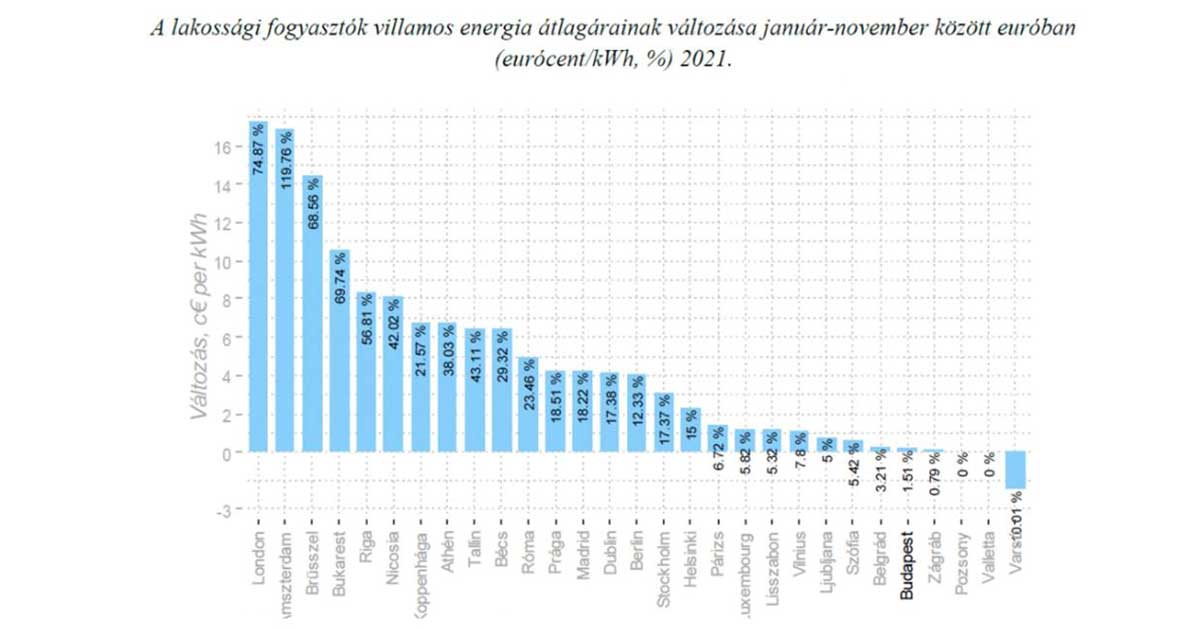
Source: MEKH
Change in the average residential consumer price of electricity in euros, January-November 2021 (eurocent/kWh, percentages)
Amsterdam
Brussels
Bucharest
Copenhagen
Athens
Tallinn
Vienna
Rome
Prague
Paris
Lisbon
Sofia
Belgrade
Zagreb
Bratislava
Warsaw
The price of electricity generated by nuclear power plants is not affected by changes in the price of natural gas or other energy carriers or by the increase in carbon dioxide quotas. In consequence, the price of electricity generated by the Paks Nuclear Power Plant remains favorable at 8-11 HUF/kWh. In addition, fuel can be purchased decades in advance, meaning that costs remain easily predictable.
An increasing number of experts are arguing that electricity from renewable solar power is becoming cheaper and approaching the price of nuclear power. This is true in the sense that the best bid received in last year’s Renewable Energy Support Scheme (METÁR) tender was 15.73 HUF/kWh. However, solar plants currently in operation are almost entirely within the mandatory feed-in tariff system and produce energy at a subsidized price of over 35 HUF/kWh.
Furthermore, if we add the additional cost of operating natural gas-fired power plants to balance the weather-dependent operation of solar (the loss of efficiency caused by switching on and off) or the cost of battery storage of the electricity generated, the above statement is no longer true.
Nuclear power saves lives
Each year, the use of nuclear power helps to avoid thousands of tons in carbon dioxide and other greenhouse gas emissions, as well as other harmful air pollutants that contribute to acid rain, smog, lung cancer and cardiovascular disease.
Nuclear power has saved around two million lives by preventing air pollution to date.
According to the U.N.’s Intergovernmental Panel on Climate Change (IPCC), nuclear power plants emit the least carbon dioxide over their entire life cycle, from construction to dismantling. The order is as follows: coal (820g/kWh); natural gas (490g/kWh); biomass (230g/kWh); solar (48g/kWh); hydropower (24g/kWh), wind (12g/kWh) and nuclear (12g/kWh). In other words, nuclear produces more carbon-free energy on a smaller land area than any other renewable energy source. A 1,000-megawatt nuclear facility needs just over a square mile to operate. According to the U.S. Nuclear Energy Institute, wind farms require 360 times more land to produce the same amount of energy; in the case of solar plants, the land area needed is 75 times larger.
The situation of nuclear energy
As for nuclear waste, one of its biggest advantages is that there is little of it, meaning that it can be stored well. All spent nuclear fuel produced by the U.S. nuclear industry over the past sixty years could fit into a football field; piled up, it would only be 9 meters high. In addition, a new type of power plant will use spent fuel as its feedstock, meaning that in the long term, there will be no waste produced at all.