



European climate policy has entered a period of rapid expansion, marked by far-reaching regulatory innovation and increasingly ambitious emissions-reduction obligations that extend beyond the traditional borders of national policymaking.
Two central developments exemplify this transformation: first, the formulation of long-term strategies for climate neutrality, such as Hungary’s 2050 pathway, which seek to define comprehensive frameworks for decarbonisation across all sectors of the economy; and second, the introduction of the Carbon Border Adjustment Mechanism (CBAM), designed to reshape international trade by aligning the carbon intensity of imports with the European Union’s domestic climate standards. Although both initiatives are presented as coherent and forward-looking responses to global environmental pressures, they also embody complex tensions between environmental ambition and economic pragmatism, raising questions about competitiveness, supply-chain stability, and the long-term resilience of national economies.
Rather than operating in isolation, climate neutrality strategies and CBAM interact with broader geopolitical and economic dynamics. National decarbonisation efforts depend not only on domestic technological change but also on access to global inputs, investment flows, and stable energy markets. Conversely, CBAM modifies the cost landscape for external suppliers of carbon-intensive goods, shifting incentives within international production networks and potentially accelerating global low-carbon transitions. In practice, however, both developments function within a world still marked by uncertainty, uneven policy implementation, and highly differentiated economic structures. The following chapters thus analyse these dynamics in detail, examining the modelling results for Hungary’s long-term climate pathway and the projected effects of CBAM on Visegrad countries.
Hungary’s 2050 Climate Neutrality Pathway
Hungary’s long-term climate strategy relies extensively on the Pathways Explorer 2050 Model, a framework that evaluates alternative decarbonisation trajectories under varying assumptions about technological deployment, sectoral restructuring, behavioural change, and macroeconomic stability. Each scenario explores different combinations of energy efficiency improvements, electrification rates, renewable energy uptake, low-carbon industrial processes, and potential shifts in household consumption patterns. The modelling reveals that climate neutrality by mid-century is technically attainable, but only under conditions of stable, long-term policy direction and coordinated investment across sectors.
A central theme of the modelling is the systemic role of energy efficiency. Reductions in energy demand lighten the burden on electricity generation, lower the cost of renewable deployment, and reduce reliance on imported fuels. Electrification, especially in transport, building heating, and selected industrial processes, emerges as a dominant mechanism for long-term decarbonisation. Yet technological substitution alone cannot guarantee success. Shifts in consumer practices, mobility patterns, and energy-use routines are equally essential. The pathway therefore underscores the need for public acceptance, affordability, and predictable cost trajectories to maintain societal support for the transition.
In addition, Hungary’s modelling emphasises the strategic value of domestic natural resources. Solar and geothermal energy offer opportunities for strengthening national self-sufficiency while reducing exposure to global supply-chain volatility. However, the pathway cautions against excessive reliance on imported technologies or scarce raw materials, advocating instead for a balanced approach that enhances economic resilience. A further insight concerns the risk of abrupt structural changes. Sudden policy shifts or rapid technological mandates could destabilise sectors that remain essential to Hungary’s industrial base. The long-term strategy, therefore, calls for an ordered transition, one that is ambitious but carefully sequenced, cost-conscious, and sensitive to the realities of national economic development.
The CBAM and Its Intended Purpose
The Carbon Border Adjustment Mechanism is the EU’s flagship instrument for addressing carbon leakage, where production relocates to jurisdictions with weaker climate regulations, and for ensuring that domestic emission-trading system (ETS) obligations do not disadvantage European producers. By applying a financial adjustment to imports of selected carbon-intensive goods such as aluminium, cement, fertilizers, iron, and steel, CBAM seeks to equalise the carbon cost burden between EU and non-EU producers. In theory, this creates a level playing field while providing global incentives for cleaner production.
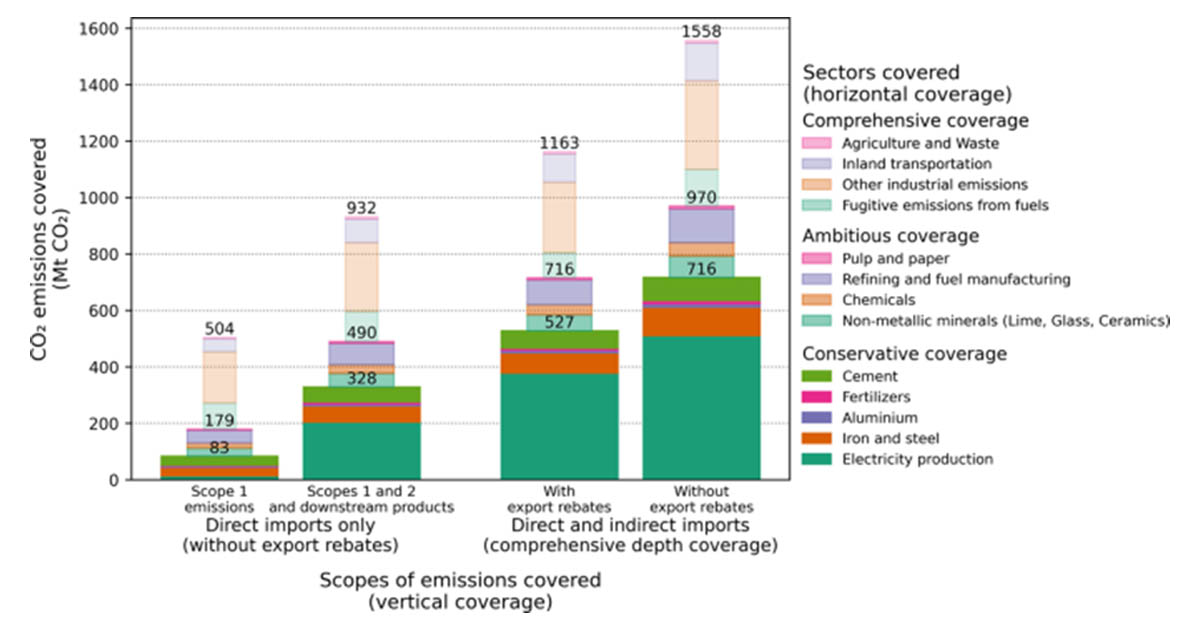
The CBAM is far more than a simple environmental equaliser. It functions as a trade instrument, a geopolitical tool, and a mechanism with significant redistributive effects across sectors and countries. Modelling for the Visegrad region confirms that the impacts are uneven. Cement, one of the most carbon-intensive commodities, faces the steepest cost increases once CBAM is fully implemented. Even modest carbon prices translate into substantial import surcharges due to the high embedded emissions of extra-EU producers.
 Source: Beaufils, T., et al. (2023).
CBAM also introduces a new layer of administrative complexity. Importers must collect emissions data, navigate verification procedures, and purchase CBAM certificates. Although these requirements are intended to encourage emission transparency globally, they impose compliance costs that are not evenly distributed across firms. Small and medium-sized enterprises may find these obligations particularly challenging. Consequently, CBAM must be recognised not only as an environmental instrument but also as a structural catalyst reshaping international trade patterns, industrial competitiveness, and domestic supply-chain configurations.
Economic Responses: Price, Import Demand, and GDP Effects
Econometric analysis of Visegrad import elasticities reveals strong sensitivity of trade flows to CBAM-induced price changes. Aluminium, cement, fertilizers, and iron and steel all demonstrate significant price responsiveness, with fertilizers exhibiting particularly high elasticity. This means that even moderate increases in carbon prices, such as those associated with early CBAM phases, lead to notable reductions in import volumes. Under high carbon prices (80-100 EUR per tonne), the decline becomes dramatic; in some cases, such as cement, imports may fall to negligible levels, effectively prompting domestic substitution or supply-side restructuring.
These trade responses translate into measurable macroeconomic effects. GDP impacts vary by country and by sector, reflecting differences in industrial composition, reliance on imports, and the ability of domestic industries to adapt. Hungary’s economy shows mixed outcomes: in lower price scenarios, some sectors experience manageable or even positive GDP effects due to reduced import competition; however, at higher carbon prices, the burden shifts, producing negative impacts as input costs rise and production becomes less competitive. Similar patterns are observed across Czechia, Poland, and Slovakia, indicating the depth of exposure that manufacturing-intensive economies face in a high-carbon-cost environment.
These insights reinforce the importance of gradual policy implementation. A sudden imposition of uniform, high carbon prices could amplify supply-chain disruptions, elevate production costs, and deter long-term investment. The modelling results therefore suggest that economic resilience is contingent on adaptive pacing, predictability, and careful sequencing of policy measures, principles consistently emphasised across the CBAM literature.
Broader Implications for National Autonomy and Strategic Planning
Climate neutrality commitments and CBAM jointly reshape the strategic environment within which national governments must operate. Long-term decarbonisation requires a coherent policy trajectory that does not compromise energy security or industrial stability. CBAM, by altering the relative competitiveness of globally traded goods, affects investment decisions, technological choices, and the structure of international economic relations.
One major implication is the heightened importance of domestic industrial capacity. If imports become more expensive due to CBAM, countries lacking adequate local production capabilities may face increased vulnerability to global volatility. Conversely, countries with strong domestic industries may benefit from reduced foreign competition. Policymaking therefore must account for the risk of supply bottlenecks, cost inflation, and potential pressures on infrastructure.
A second implication concerns the balance between EU-level harmonisation and national differentiation. While the EU aims to create a uniform regulatory environment, member states differ significantly in their economic structures, energy mixes, and vulnerability to carbon-price volatility. Effective implementation must therefore allow space for national strategies that support economic continuity, social stability, and long-term competitiveness. Without such flexibility, policies may generate political resistance or yield counterproductive economic outcomes.
Finally, both CBAM and climate-neutrality pathways contribute to a broader debate about the future of European economic sovereignty. As global climate policies evolve, Europe’s regulatory leadership may strengthen its strategic position, but only if transitions are managed in a manner that sustains industrial viability and secures public support.
Conclusion
The evidence from Hungary’s 2050 climate-neutrality modelling and the CBAM simulations for Visegrad countries conveys a clear and consistent message. Ambitious climate goals must be matched with careful governance, economic realism, and a commitment to policy predictability. Hungary’s pathway demonstrates that climate neutrality is achievable, but only through sustained societal support, stable policy signals, and an orderly, sequenced transition that respects existing industrial structures. Likewise, CBAM holds the potential to reduce carbon leakage and strengthen Europe’s climate architecture; however, its implementation must reflect the complex way in which price signals reshape trade patterns, production decisions, and macroeconomic performance.
Ultimately, the success of both initiatives rests on integrating environmental ambition with economic stability. Climate policy must be transformative but not destabilising; forward-looking but grounded in current realities; globally oriented yet attentive to national resilience. Only by aligning ambition with prudence can Europe ensure that its climate transition strengthens, rather than undermines, the foundations of long-term prosperity.
References
Beaufils, T., Ward, H., Jakob, M., & Wenz, L. (2023). Assessing different European Carbon Border Adjustment Mechanism implementations and their impact on trade partners. Communications Earth & Environment, 4, Article 131.
Böhringer, C., Balistreri, E. J., & Rutherford, T. F. (2012). The role of border carbon adjustment in unilateral climate policy: Overview of an Energy Modeling Forum study (EMF 29). Energy Economics, 34(S2), S97–S110.
Böhringer, C., Carbone, J. C., & Rutherford, T. F. (2011). Embodied carbon tariffs. NBER Working Paper No. 17376.
Dobranschi, M., Nerudová, D., Solilová, V., & Stadler, K. (2024). Carbon border adjustment mechanism challenges and implications: The case of Visegrád countries. Heliyon, 10, e30976.
Flórez Mendoza, J., Reiter, O., & Stehrer, R. (2024). Impacts of the EU carbon border adjustment mechanism. Vienna Institute for International Economic Studies.
Maliszewska, M., Fischer, C., Jung, E., & Chepeliev, M. (2025). Reproducibility package for Carbon Border Adjustment Mechanism (CBAM) Exposure Indices – Methodological Note. World Bank Policy Research Working Paper No. RR_WLD_2025_343.
Rodrigues Aldeia, S. C. (2025). The European Union Carbon Border Adjustment Mechanism as a Green Tax Policy Instrument. Central European Economic Journal, 12(59), 85–101.