


As the first cool nights of autumn approach, Hungary faces the familiar challenge of ensuring reliable energy supply for the heating season. Natural gas remains the backbone of winter energy consumption, powering household heating, industrial facilities, and district heating systems.
Over the past year, Hungary has taken significant steps to strengthen its energy security, including expanding domestic production, diversifying import sources, investing in infrastructure, and developing strategic reserves. Beyond supply, the economic implications of winter preparedness, such as potential price fluctuations, consumer affordability, and industrial costs, are increasingly significant in energy planning. This article provides a comprehensive overview of Hungary’s winter preparedness, emphasizing economic considerations and lessons from past winters.
Domestic Gas Production and Its Economic Significance
Hungary has successfully increased domestic gas production in recent years, providing both supply security and economic benefits. MOL company reported several new gas discoveries, adding to the domestic output available for the winter season. Simultaneously, MVM’s entry into upstream production, including its 5% stake in a major Azeri field, is expected to contribute roughly 1.5 billion cubic meters annually to the Hungarian gas system.
From an economic perspective, higher domestic production reduces dependence on imports, helping to stabilize domestic gas prices. By supplying a portion of Hungary’s needs from local sources, the country can avoid exposure to volatile international markets. Furthermore, domestic production supports jobs in the energy sector, stimulates investment in technology and infrastructure, and contributes to tax revenues and local economies, critical factors during a winter when household heating bills rise.
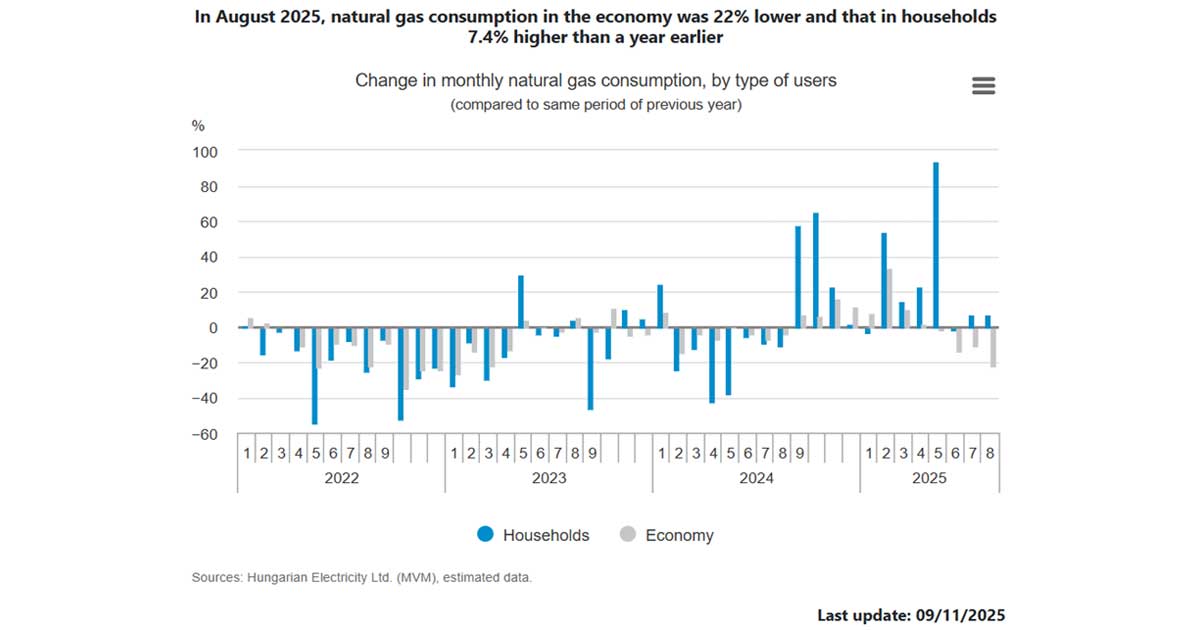
Domestic natural gas consumption has declined to around 8.5 billion cubic meters annually. This reduction is the result of several interrelated factors. Energy efficiency improvements across households and businesses have gradually lowered overall demand, while modernization of industrial systems has reduced the intensity of gas use in production processes. In addition, the partial electrification of heating, supported by both technological change and policy incentives, has contributed to easing dependence on gas for residential energy needs.
At the same time, the weakening economic performance has also played a role. Sluggish growth and reduced industrial output have diminished gas requirements in the production sector, while stagnant or declining household purchasing power has limited energy consumption in the residential sphere. This dual impact, on industry and on households, is expected to be reflected in the forthcoming chart comparing household and industrial consumption. Together, these structural and cyclical drivers explain the current lower level of demand. Combined with an increase in domestic supply, they reduce Hungary’s import dependency and mitigate the potential economic impact of high international gas prices during periods of cold weather.
Diversification of Imports and LNG Contracts
Despite increased domestic production, Hungary remains reliant on imports for a significant portion of its gas supply. Strategic diversification of supply routes and contracts helps minimize the economic risks of potential supply disruptions or price spikes.
MVM’s recent long-term LNG contract with Shell ensures access to flexible liquefied natural gas supplies. LNG imports allow Hungary to supplement traditional pipeline deliveries and can be crucial during periods of peak demand. The availability of multiple import sources improves negotiating power, stabilizes market prices, and reduces the risk of supply shocks that could escalate heating costs for households and industry.
In addition, infrastructure improvements, including expanded interconnectors with Slovakia and Romania, and a planned new connection to Serbia, allow gas to flow in either direction depending on demand and price. The Krk LNG terminal in Croatia adds further flexibility by opening access to global LNG supplies. These diversification measures not only strengthen Hungary’s own energy security but also enhance regional resilience. Hungary traditionally provides natural gas storage services for Serbia, meaning that higher storage capacity and reliable infrastructure on Hungarian territory contribute directly to the stability of its southern neighbor as well. In this way, Hungary’s infrastructure development plays a dual role: securing domestic needs while supporting regional partners. Together, these developments help mitigate economic exposure to geopolitical tensions and international market volatility.
Storage Management: Economic Benefits and Strategic Reserves
Storage capacity plays a critical role in Hungary’s winter preparedness strategy. Underground storage facilities allow gas to be injected during low-demand periods and withdrawn during peak winter consumption. This seasonal management ensures continuous supply, stabilizes market prices, and prevents extreme volatility.
Economically, well-managed gas storage plays a critical role in stabilizing the market, as it can reduce price spikes during cold snaps by providing a readily available buffer of supply. High storage levels also limit the need for costly emergency imports, which are often subject to volatile international market prices. By maintaining substantial reserves, authorities can smooth seasonal fluctuations in demand, ensuring that both households and industrial users have reliable access to gas even during periods of extreme cold. Typically, the goal is to fill storage facilities to at least 80–90% of capacity before the onset of winter, creating a strategic reserve that not only cushions consumers and businesses against sudden price shocks but also enhances overall economic resilience.
This approach is reinforced by EU Regulation 2022/1032, introduced in response to the Russian- Ukrainian conflict. The regulation obliges member states to maintain a mandatory proportion of gas in national storage facilities, ensuring that security reserves are available not only for domestic needs but also for other countries in times of crisis. In practice, this means that Hungary’s storage system serves a dual purpose: it stabilizes the national market and contributes to broader regional energy security, particularly for neighboring countries like Serbia that rely on Hungary’s storage capacity during emergencies.
Furthermore, the existence of substantial reserves allows Hungary to participate more effectively in regional gas trading. By leveraging storage strategically, the country can optimize procurement costs, reduce reliance on spot markets, and limit the economic impact of unexpected market disruptions. In this way, effective storage management is not only an economic tool but also a strategic instrument for regional stability, helping to mitigate the impact of geopolitical tensions, international market volatility, and conflict-related disruptions in supply.
Infrastructure Enhancements and Economic Implications
Infrastructure is a cornerstone of Hungary’s winter preparedness, with direct implications for both domestic and regional economic stability. Pipeline networks, interconnectors, compressor stations, and pressure management systems are routinely maintained and upgraded to ensure reliable gas delivery throughout the country. Even minor disruptions in flow can have cascading effects: industrial plants may face temporary shutdowns, households could experience higher heating costs, and authorities might be forced to implement costly emergency measures. Beyond immediate domestic impacts, any supply interruption can also affect regional markets, particularly for countries that rely on Hungary’s storage and transit capacity. Robust infrastructure not only mitigates these risks but also enables Hungary to respond flexibly to changing demand patterns, optimize gas imports and exports, and maintain a stable economic environment during periods of extreme weather or geopolitical tension. In this sense, infrastructure investment is not simply a technical necessity but a strategic economic safeguard, underpinning both national energy security and Hungary’s role in the wider Central and Southeast European energy network.
A significant development in this context is the gas solidarity agreement signed between Hungary and Romania in March 2025. This historic agreement enhances bilateral energy cooperation, ensuring mutual protection for consumers in both countries under fair conditions. The agreement is particularly timely as Romania is poised to become the region’s sole net gas exporter and the European Union’s largest producer, thanks to the Neptun Deep Black Sea project. This expansion positions Romania as a key player in regional energy security. The agreement also builds upon existing infrastructure, including the recently upgraded interconnector between Hungary and Romania, which now allows for the annual transport of 2.6 billion cubic meters of gas. In 2024, 1.8 billion cubic meters were traded through this link, contributing significantly to the energy security of both nations.
Investments in interconnectors and cross-border pipelines further enhance flexibility, allowing Hungary to import gas from the most cost-effective sources. These improvements not only secure supply but also help optimize procurement costs, reducing the risk of price spikes. For industries with high gas consumption, such as the chemical and manufacturing sectors, stable supply at predictable prices is essential to maintain competitiveness and avoid production losses. By combining strategic infrastructure investments with strong bilateral agreements, Hungary strengthens both its domestic market stability and its role as a reliable partner in regional energy security, ensuring resilience against geopolitical tensions and market volatility.
Lessons from Past Winters
Past winters provide valuable insights into the economic implications of winter preparedness. Severe cold spells in Hungary and neighboring countries have historically led to spikes in demand, price volatility, and strain on supply networks. For example, the winter of 2017-2018 saw unusually low temperatures (In January 2017, the village of Tésa in northern Hungary recorded an unprecedented low of -28.1°C on January 8, setting a national record for that time of year. Budapest also experienced severe cold, with temperatures dropping to -16.6°C on January 8, well below the average low of -4.2°C for that date) across Central Europe, causing increased gas consumption and temporary shortages in some regions. Hungary mitigated these challenges through high storage levels and regional interconnector support, avoiding prolonged supply interruptions.
Similarly, during the winter of 2021-2022, disruptions in pipeline flows from Eastern Europe coincided with a surge in international gas prices. Hungary’s diversified import strategy, including LNG and Azeri gas stakes, helped buffer domestic consumers from the worst price impacts. These examples underscore the economic value of proactive planning, flexible supply chains, and strategic storage.
Consumer Preparedness and Economic Impacts
Household preparedness also affects economic outcomes. Early communication from energy authorities about winter supply, potential price trends, and energy efficiency measures enable consumers to manage heating costs. Practical steps, such as maintaining boilers, insulating homes, and adjusting thermostat settings, can reduce consumption, stabilize demand and limit price spikes during peak periods.
For businesses, particularly in energy-intensive industries, winter preparedness strategies involve careful coordination with suppliers and operational planning to minimize the impact of potential shortages or high gas prices. These measures have direct economic implications, reducing the risk of lost production, unplanned costs, and competitive disadvantages.
Economic Implications of Winter Preparedness
Winter preparation extends beyond technical supply measures; it has profound economic implications across multiple sectors:
Household Expenditures: Gas prices directly affect heating bills. Strategic storage, diversified supply, and domestic production help limit price volatility, protecting household budgets during the coldest months.
Industrial Competitiveness: Industries reliant on natural gas require stable, predictable supply at reasonable costs. Winter preparedness ensures that manufacturing and processing activities can continue without costly interruptions, preserving economic output and employment.
Government Expenditures: State involvement in storage, strategic reserves, and infrastructure development represents significant public investment. Effective winter preparedness maximizes the return on these investments by preventing emergencies, reducing the need for emergency procurement, and avoiding subsidies to compensate for extreme price spikes.
Market Stability: By smoothing seasonal fluctuations in supply and demand, winter preparedness contributes to more stable domestic gas markets. Predictable pricing encourages investment, supports long-term contracts, and reduces reliance on volatile spot markets.
Macroeconomic Resilience: During harsh winters, spikes in energy costs can ripple through the economy, affecting inflation, disposable income, and business investment. Proactive preparedness mitigates these effects, contributing to broader economic stability.
Pricing Strategies and Potential Effects
Hungary’s combination of domestic production, imports, storage, and infrastructure improvements enables effective management of gas prices during the heating season. By maintaining storage reserves, diversifying import sources, and closely monitoring market trends, energy companies can avoid reactive purchases at high spot-market prices.
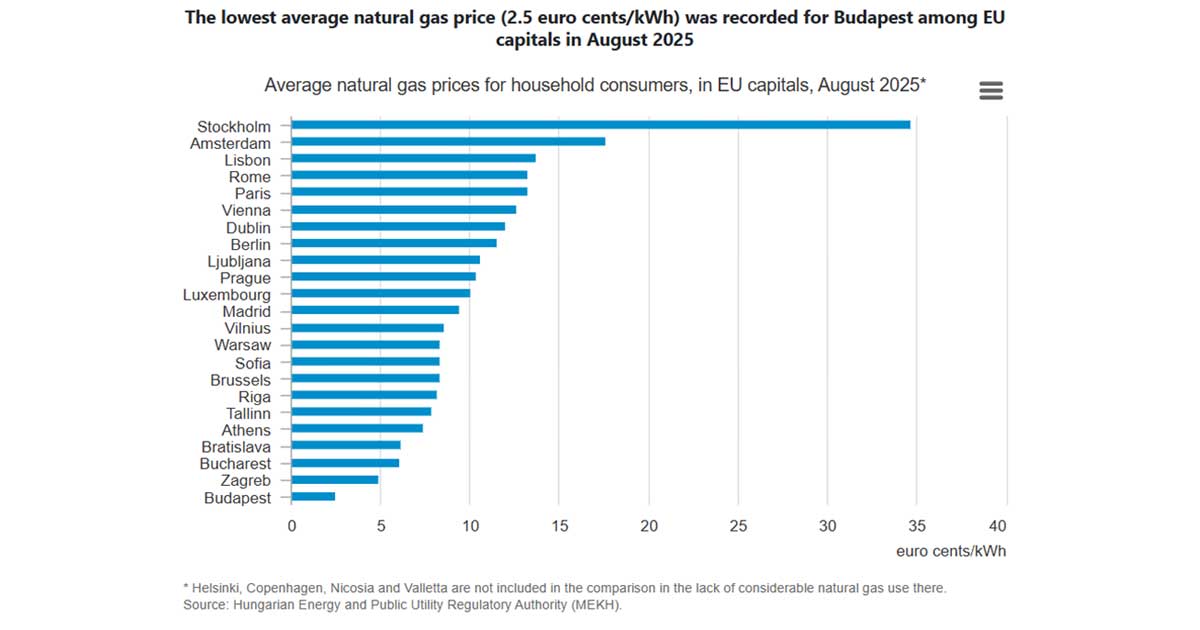
Even modest increases in domestic production or more efficient use of storage can significantly reduce price volatility, potentially by 10-20% during peak demand periods. This stability benefits both households and industries, preventing sudden spikes in heating bills or operational costs during cold periods. Access to multiple import channels further strengthens this effect, allowing buyers to choose the most cost-effective supply sources and reducing dependence on a single market or supplier. For industrial users, particularly in energy-intensive sectors such as chemicals and manufacturing, this translates into more predictable energy costs, supporting production continuity and competitiveness. For households, it means more stable heating bills, helping to limit the economic strain of sharp price increases and contributing to overall energy security.
Policy measures complement these market tools. Regulated tariffs, targeted subsidies for vulnerable households, and incentives for energy efficiency all help mitigate economic burdens. Together, these strategies reduce the risk of excessive winter heating costs while preserving market incentives for private energy providers.
In addition, recent warnings from the United States against purchasing Russian fossil fuels in the long term have important implications for Hungary and the wider European market. Following these recommendations could lead to a sharp rise in natural gas costs, as alternative supplies, particularly US LNG, are significantly more expensive. While some critics argue that European TTF spot prices are converging with Russian gas prices, the Russian price typically includes most transfer and logistics costs, whereas Western market prices do not. Furthermore, US LNG imports are not only costlier but also have a higher climate impact, making them less favorable from both economic and environmental perspectives. These developments highlight the importance of Hungary’s strategy to rely on diversified supply sources, domestic production, and storage to maintain price stability and energy security, while avoiding overexposure to more expensive and climate-intensive alternatives.
International Context and Economic Significance
Hungary’s winter preparedness strategy also intersects with international economic considerations. The U.S.-EU discussions regarding LNG supply illustrate the potential economic effects of global negotiations on domestic prices. While formal agreements are pending, Hungary’s diversified import strategy, including LNG contracts and investment in Azeri gas, helps insulate domestic consumers and industries from international price volatility.
Additionally, cross-border interconnectors with Slovakia, Romania, and soon Serbia allow Hungary to participate in regional gas markets, optimizing procurement costs and benefiting from economies of scale. These arrangements enhance both energy security and economic efficiency, demonstrating the importance of international cooperation in domestic winter preparedness.
Outlook for the 2025-2026 Heating Season
Entering the 2025-2026 winter, Hungary’s energy system is better prepared than in previous years. Increased domestic production, reduced consumption, diversified imports, robust storage, and enhanced infrastructure collectively strengthen both supply security and economic resilience.
Households can expect more stable heating costs, industries benefit from predictable supply and pricing, and the government can rely on strategic reserves to buffer against extreme events. Lessons from past winters underscore the importance of proactive planning, flexible supply chains, and economic foresight in preventing disruptions and mitigating price shocks.
Conclusion
Hungary’s winter preparedness strategy demonstrates a comprehensive approach to energy security that combines technical, strategic, and economic considerations. Domestic production, import diversification, storage management, infrastructure investment, and consumer engagement collectively ensure reliable supply during peak winter demand.
The economic implications are profound. Effective winter preparation stabilizes household expenditure, protects industrial competitiveness, optimizes public investment, and contributes to broader market and macroeconomic stability. By combining domestic capabilities with international cooperation and strategic foresight, Hungary is well-positioned to face the challenges of the 2025-2026 heating season with resilience, efficiency, and economic prudence.
References
Carnegie Endowment for International Peace. (2025, April 22). How Eastern Europe overhauled its natural gas market. Retrieved from https://carnegieendowment.org/research/2025/04/how-eastern-europe-overhauled-its-natural-gas-market?lang=en
European Commission. (2021). Preventive Action Plan for the security of natural gas supply in Hungary. Retrieved from https://energy.ec.europa.eu/system/files/2021-04/hu_pap_draft_en_0.pdf
European Gas Hub. (2025, April 22). European gas storage capacity vs winter demand in CEE. Retrieved from https://europeangashub.com/european-gas-storage-capacity-vs-winter-demand-in-cee.html
Hungarian Central Statistical Office. (2025, September 11). HCSO Monitor – Energy. https://www.ksh.hu/hcso-monitor/energy.html
Hungarian Natural Gas Storage Association. (2024, September 5). Hungary exceeds EU gas storage targets, ensuring secure energy supply for winter. Retrieved from https://ceenergynews.com/oil-gas/hungary-exceeds-eu-gas-storage-targets-ensuring-secure-energy-supply-for-winter/
International Energy Agency (IEA). (2022, August 10). Hungary Natural Gas Security Policy – Analysis. Retrieved from https://www.iea.org/articles/hungary-natural-gas-security-policy
MVM Group. (2024, June 5). Hungary to buy 5% stake in Azerbaijan's Shah Deniz gas field. Retrieved from https://www.reuters.com/business/energy/hungary-buy-5-stake-azerbaijans-shah-deniz-gas-field-2024-06-05/
Reuters. (2025, September 9). Shell inks 10-year gas deal with Hungary's MVM CEEnergy. Retrieved from https://www.reuters.com/business/energy/shell-inks-10-year-gas-deal-with-hungarys-mvm-ceenergy-2025-09-09/
S&P Global. (2022, August 22). Supply shocks in Europe push Hungarian gas market into limelight. Retrieved from https://www.spglobal.com/commodity-insights/en/news-research/blog/natural-gas/082224-supply-shocks-in-europe-push-hungarian-gas-market-into-limelight
World Oil. (2025, September 10). Partners MOL, O&GD strike oil in Hungarian field. Retrieved from https://www.worldoil.com/news/2025/9/10/partners-mol-o-gd-strike-oil-in-hungarian-field/